IPL matches to be increased to 94 from 2028
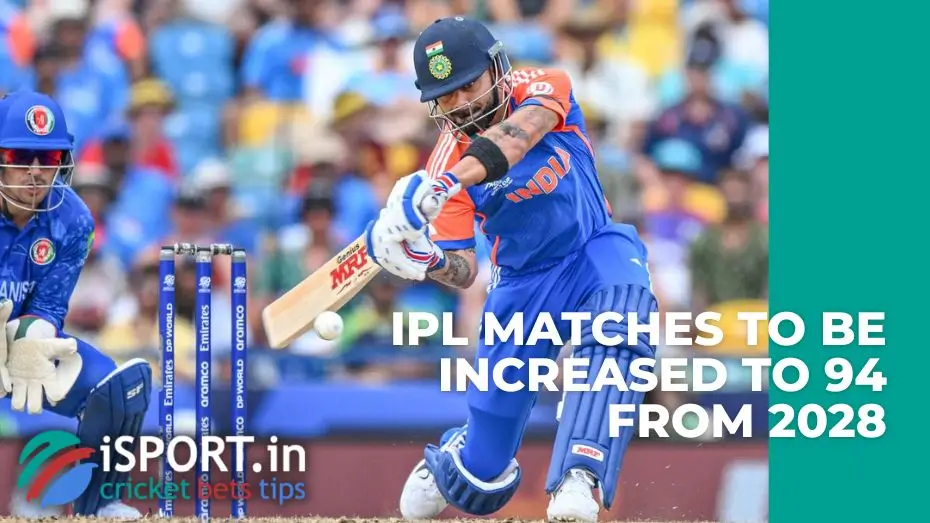
It seems Indian cricket is preparing for a major shakeup. Just the other day, Arun Dhumal dropped a phrase that has fans around the world in high anticipation of what’s to come: IPL matches to be increased to 94 from 2028. Behind this news lies a desire to completely redesign the tournament format.
IPL matches to be increased to 94 from 2028: what will it give
Now that the IPL features 10 teams, organizers are forced to use a virtual group system. Not all teams face each other twice. To be honest, even die-hard fans sometimes get confused by the tournament standings. By the middle of the championship, interest often wanes—this, incidentally, is confirmed by the broadcasters themselves: viewership figures are declining.
Now let’s describe a different scenario. Each of the ten teams plays two matches against each of the nine opponents—home and away. A simple round-robin system, like in the English Premier League, La Liga, or Serie A. No subgroups, no weird calculations. Every match is equally important. And that’s exactly what the BCCI is proposing, starting in the 2028 season.
IPL matches to be increased to 94 from 2028, but why exactly that much? It’s easy to calculate: 10 teams play each other 9 x 2 = 18 rounds, with 5 matches in each round. A total of 90 matches plus the playoffs with the final. That’s 94. Incidentally, that’s how the IPL worked when there were eight teams. Then the Gujarat Titans and Lucknow Super Giants joined, making it ten, and the good old system had to be abandoned.
IPL matches to be increased to 94 from 2028: main obstacles
And here the first problem arises. Where to find the time? The current season—in 2026, for example — fits into 60–65 days. The tournament started on March 28, and the final is scheduled for May 31. Moreover, double-match days (two matches in one day) only occur on weekends, and not even every Saturday. And 94 games would require about two and a half months of pure time.
You can’t simply add more double days, and it all comes down to money. Broadcasters frankly dislike double- headlines. Viewership declines, and advertising revenues fall. Simply put, two cricket matches in a row don’t mean twice the profit, but rather less from each one. Therefore, the BCCI is looking for a calendar solution rather than a technical one.
The main difficulty is the international schedule. The ICC Future Tours Programme is scheduled until 2027. Literally everything is booked: international series, Test windows, one-day matches, and World Twenty matches. As Dhumal himself put it: “Since the bilateral series are fixed until 2027, we’ll need a longer window to increase the number of matches from 74 to 94. Therefore, we’re looking at the window after 2027. If possible, we’ll definitely make 94 matches.”
So, essentially, fans shouldn’t expect any changes in the next two seasons. 2026 and 2027 will continue as before. But starting in 2028—if negotiations with the ICC are successful—the Indian Championship could get an exclusive two-and-a-half-week window, during which international cricket will be virtually at a standstill. However, these are just plans for now. It would be naive to think that all federations will easily agree to free up the calendar.
Speaking of expanding the league with new teams, Dhumal made it clear: “With the current team composition, we can only increase the number of matches. Therefore, there’s no point in increasing the number of franchises now. To have an equal number of home and away games, we can go up from 74 to 94. That’s the ideal option.” This means that the same 10 teams will remain in the IPL. No Rising Pune Supergiant or Gujarat Lions (who have appeared as temporary replacements in the past) are in the offing.
In the current system, due to virtual groups, some strong opponents only meet once a season. This is, to put it mildly, offensive for the teams and boring for the spectators. Moreover, a single tournament table, like in football championships, is intuitively understandable to anyone. Just look at the points and it’s immediately clear who’s a contender and who’s an underdog.
Of course, the question of price remains. IPL matches to be increased to 94 from 2028, but this is a huge burden on the players, coaching staff and support staff. Even now, star players are complaining about their busy schedules and flights. The BCCI is apparently counting on squad rotation and a deeper pool of local talent. But there’s a risk here: there’s a lot of talent, but not all of them are ready for the IPL level without losing quality. For now, the board believes that ten strong teams is the maximum that can be supported without diluting the level.
An interesting detail: in previous years, when the league experimented with different numbers of participants, there were one-day seasons. For example, Pune Warriors India and Kochi Tuskers Kerala appeared and disappeared. And in 2016-2017, while Chennai and Rajasthan were serving suspensions, they were replaced by Rising Pune and Gujarat Lions. But never in 18 seasons have there been 94 games.
Changes are possible, but not before 2028 and only if the BCCI agrees to a longer window in the international calendar. The format promises to be simpler and fairer, and more exciting to watch. However, not everything depends on the Indian federation alone. There are too many players and interests at stake. All that remains is to wait for official documents and monitor negotiations with the ICC.