ICC World Cup 2027 Format
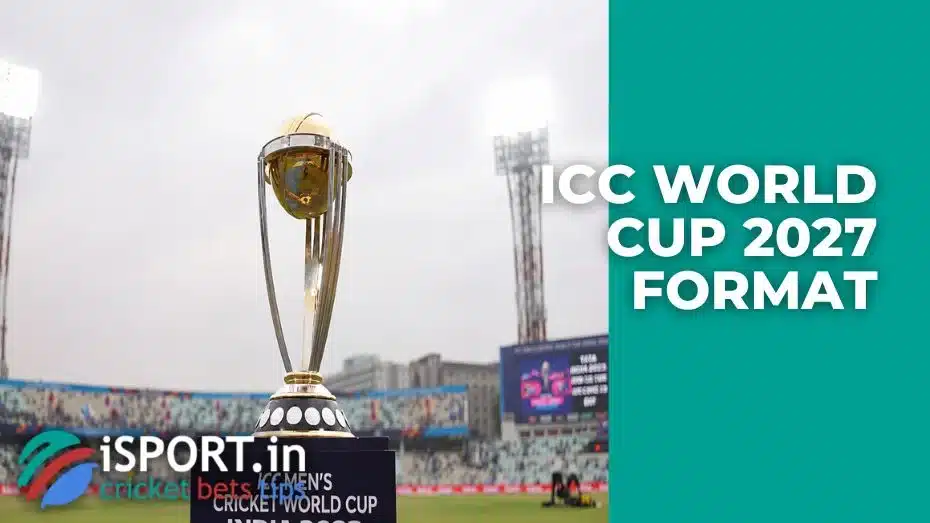
The ICC has unveiled a revamped format for the 2027 Men’s Cricket World Cup that will significantly shake up the tournament’s familiar structure. The new ICC World Cup 2027 format will feature a preliminary Super Series, a main group stage and an additional Super 7 round before the semi-finals. In this article, we explain how the new system will work, which teams could gain an advantage and why the ICC’s decision has already sparked controversy.
ICC World Cup 2027 Format: When Were the Changes Approved?
On 15 July 2026, the International Cricket Council announced changes to the structure of the 2027 Men’s ODI World Cup. The decision was approved by the ICC Board during the organisation’s Annual General Meeting in Edinburgh. According to the ICC, the revamped format is designed to raise the level of competition, make each match more meaningful and improve the overall tournament experience for both players and fans.
The key changes to the ICC Men’s Cricket World Cup 2027 are as follows:
- The tournament will still feature 14 national teams.
- The competition will be split into three main rounds.
- The three lowest-seeded teams will begin their campaign in the Super Series, with only one team advancing.
- The main stage will feature 12 teams divided into two groups, with a total of 30 matches.
- The top seven teams will move on to the new Super 7 round, which will consist of 21 matches.
- Four teams from the Super 7 will qualify for the semi-finals.
The 2027 World Cup will be jointly hosted by South Africa, Zimbabwe and Namibia. Of course, even though the number of participating teams will remain unchanged, the tournament structure will become considerably more complex.
Changes to the ICC Men’s T20 World Cup 2028 Format
The changes will not be limited to the 2027 ODI World Cup. The ICC Men’s T20 World Cup 2028, which will be jointly hosted by Australia and New Zealand, is also set for a major revamp.
During the opening stage, the 20 participating teams will be divided into five groups of four instead of the four groups of five used at the 2026 T20 World Cup. The teams in each group will play one another, with the top two sides progressing to the Super 10. A total of 30 matches will be played during the first stage.
In the Super 10 round, the ten remaining teams will be split into two groups of five. The winner of each group will book a direct spot in the semi-finals, while the teams finishing second and third will have to make it through an additional Eliminators stage. The second-placed team from one group will face the third-placed side from the other.
The winners of the two Eliminator matches will claim the remaining semi-final spots. The revamped format is therefore expected to give emerging cricket nations a better chance of reaching the later stages of the competition. At the same time, however, it will make the road to the tournament’s decisive matches longer and more demanding.
Qualification for the ICC Men’s T20 World Cup 2028
The qualification process for the ICC Men’s T20 World Cup 2028 should not be overlooked either, as major changes are also in the pipeline. Twelve teams have already secured their places based on their results at the ICC Men’s T20 World Cup 2026 and their positions in the rankings: Afghanistan, Australia, Bangladesh, England, India, Ireland, New Zealand, Pakistan, South Africa, Sri Lanka, the West Indies and Zimbabwe.
The remaining eight spots will be allocated as follows:
- Sixteen teams will compete in a new global qualifying tournament.
- Canada, Italy, Namibia, Nepal, the Netherlands, Oman, the United Arab Emirates and the United States will qualify directly for the event.
- Another eight participants will be determined through regional qualifying tournaments.
- Africa, Asia and Europe will each receive two places in the Global Qualifier.
- The Americas and the East Asia-Pacific region will each receive one place.
- As an exception, Scotland will enter the qualification process at the European Regional Final stage.
At the Global Qualifier itself, the best-performing team from each region will earn a place at the World Cup, along with three additional teams boasting the strongest records in the overall standings. However, the ICC will also set minimum performance criteria, meaning that a favourable position in the table alone may not be enough to secure qualification.
It is important to point out that not all of these decisions are final. The formats for the 2027 and 2028 tournaments have already been approved by the ICC Board, but the new qualification system for the 2028 T20 World Cup will only be finalised after it is reviewed at the meetings scheduled for November.