India Chase 226 Against New Zealand
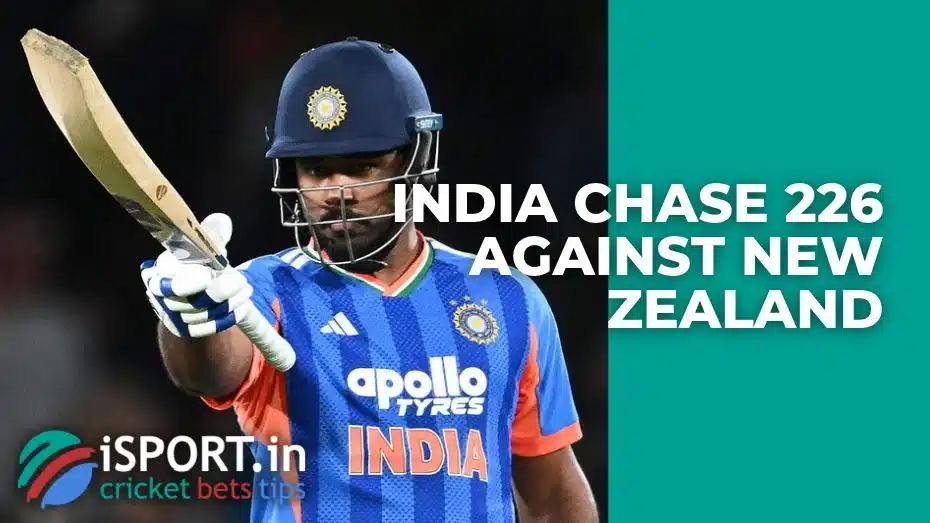
India’s victory at Hagley Oval required three distinct batting performances: an aggressive opening partnership, a recovery through the middle overs and a decisive finish. New Zealand repeatedly threatened to regain control, but the visitors completed a four-wicket win with two deliveries remaining on 22 October, taking a 1-0 lead in the five-match series.
Samson’s Powerplay Assault Changes the Equation
The India Chase 226 Against New Zealand began with little room for a cautious start. A target demanding 11.30 runs per over placed immediate pressure on the opening pair, particularly against a new ball offering movement.
Sanju Samson and Abhishek Sharma responded by attacking the field restrictions. Their partnership yielded 93 runs before Abhishek departed for 29 from 12 deliveries. India completed the powerplay at 94/1, establishing a substantial advantage over New Zealand’s corresponding score of 65/1. Samson went on to make 67 from 33 balls, combining eight fours with four sixes.
The tactical value of that acceleration extended beyond the boundary count. With 132 still required from 84 balls after six overs, India had reduced the asking rate to approximately 9.43. The chase remained demanding, but the openers had created breathing space for the batters who followed.
Samson’s approach also reflected a deliberate response to the conditions. In his post-match assessment, he explained that the opening pair recognised the swing but chose to trust their strengths, focusing on balance, watching the ball and timing their strokes. His innings earned him the Player of the Match award.
Earlier, Glenn Phillips had provided the backbone of New Zealand’s 225/4 with an unbeaten 82 from 40 deliveries. His fourth-wicket partnership with Bevon Jacobs added 73, allowing the hosts to sustain their scoring momentum deep into the innings. Bhuvneshwar Kumar’s return to international cricket proved expensive, with the seamer conceding 49 runs without taking a wicket.
Those figures underline why India needed such a forceful reply. Their bowlers had left the batting unit a considerable task, and an ordinary powerplay would have pushed an even greater burden onto the middle order.
Iyer Rebuilds Before Dhir Wins the Death-Overs Battle
The India Chase 226 against New Zealand became considerably less comfortable when Samson, Tilak Varma and Ishan Kishan fell in consecutive overs. The rapid loss of wickets interrupted India’s scoring rhythm and gave the hosts a route back into the contest.
Shreyas Iyer supplied the stabilising innings. His 42 from 28 balls included partnerships with Axar Patel and Naman Dhir before he was dismissed in the 19th over. Those contributions kept India within striking distance without requiring the remaining batters to rebuild from a standstill.
In tactical terms, this was a different assignment from the one the openers had faced. During the powerplay, attacking the gaps could produce immediate boundaries. After the field spread and wickets fell, India needed to balance strike rotation with selective aggression. Simply preserving wickets would have allowed the required rate to climb; attacking every delivery would have risked exposing the lower order too early.
Dhir supplied the final acceleration. He finished unbeaten on 42 from just 15 balls, a strike rate of 280.00, and struck Matt Henry for six from the fourth delivery of the final over. India closed on 230/6 after 19.4 overs.
The contrast between Iyer’s and Dhir’s scoring rates helps explain their complementary roles. Iyer’s contribution maintained the chase through disruption, while Dhir compressed the remaining task into a brief burst of boundary hitting. India needed both: continuity before the finish and sufficient power to complete it.
For New Zealand, the result leaves a clear tactical question. Their middle-overs breakthroughs demonstrated that they could interrupt India’s momentum, but the damage conceded during the field restrictions had already reduced their margin for error at the death.
For India, the batting depth was encouraging, although the victory should not obscure the work required with the ball. A successful chase of this scale is an outstanding result; tighter bowling would make the next assignment considerably more manageable.